Stainless relining vs flashing repair
Relining fixes the flue at $1,500-$4,000; flashing repair seals the roof line at $400-$1,500. Two repairs that are constantly confused when a chimney leaks.
A stainless liner replaces the flue at $1,500 to $4,000 and fixes venting. Flashing repair seals the roof-line joint at $400 to $1,500 and fixes water entry. A leak is a flashing question far more often than a liner question.
- Relining
- $1,500 - $4,000
- Flashing repair
- $400 - $1,500
- Crown repair
- $400 - $1,500
- Cap
- $150 - $600
- Inspection
- $150 - $800
Some links on this page are affiliate links.If you buy through them we may earn a commission at no extra cost to you. We do not accept payment for rankings. Read the full disclosure.
Stainless relining and flashing repair are the two repairs most often mixed up when a chimney leaks, and they address opposite ends of the structure. Relining replaces the flue at $1,500 to $4,000. Flashing repair seals the roof-line joint at $400 to $1,500. If the symptom is water, the flashing is the more likely culprit by a wide margin.
Two systems, two symptoms
The flue carries combustion gases out of the building. Its failure shows as venting symptoms: poor draught, smoke spillage, corrosion on metal parts, or a camera finding of cracked tile.
Flashing seals the joint between the chimney and the roof. Its failure shows as water: staining on the chimney breast, damp masonry below the roof line, a leak in wind-driven rain.
One is a venting system. The other is part of the building envelope.
Head to head
| Attribute | Stainless relining | Flashing repair |
|---|---|---|
| System | Flue | Roof-line joint |
| Symptom | Draught, spillage, corrosion | Water staining, damp |
| Cost | $1,500 - $4,000 | $400 - $1,500 |
| Trade | Chimney technician | Roofer or mason |
| Trigger | Camera inspection | Storm or rain observation |
| Fixes the other | No | No |
Why the confusion happens
A leak is alarming, and “chimney” is the word attached to it. A contractor who sells liners may diagnose a liner; a roofer may diagnose flashing.
The symptom timing resolves it. A leak that appears only in wind-driven rain points to flashing, because wind pushes water sideways into a joint gravity would not reach.
A leak in any heavy rain, tracking down the stack, points to the crown above.
A leak that appears with the appliance running, or that comes with draught problems, points to the flue.
What each repair involves
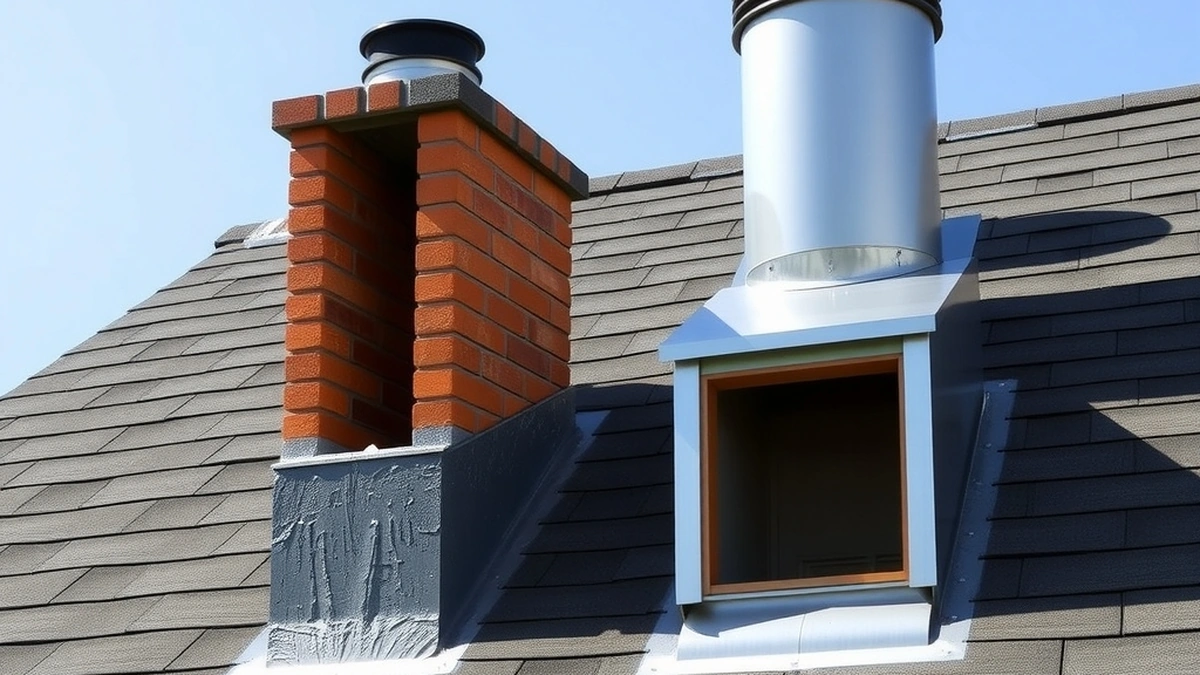
Flashing repair removes the old metal, cuts a reglet into the masonry for the counter-flashing, weaves step flashing into the shingles, and seals the joint. It is roof-line work at $400 to $1,500.
Relining lowers a steel tube down the flue, connects it to the appliance, and fits a terminal at the top. It is venting work at $1,500 to $4,000.
Neither scope includes the other, and neither trade should be performing the other’s work.
Cost of doing both
Flashing at $400 to $1,500. Stainless liner at $1,500 to $4,000. Total: $1,900 to $5,500.
Add a crown at $400 to $1,500 and a cap at $150 to $600, and the top-of-chimney work reaches $2,450 to $7,600.
A partial rebuild at $5,000 to $15,000 is the alternative if the water has been entering for years.
When a chimney has both problems.
Old chimneys rarely have one defect. A thirty-year-old stack often has eroded flashing, a crown that has seen better days, and a flue that no longer suits the appliance.
That combination is worth pricing as one project rather than three. The access is shared, the inspection is shared, and a single written report makes it harder for either trade to leave a defect unmentioned.
Budget for it in order: flashing at $400 to $1,500, crown at $400 to $1,500, cap at $150 to $600, then the liner at $1,500 to $4,000. That is $2,450 to $7,600, and it is still below the partial rebuild band.
The sequence, and when a chimney has both
- Stop using the appliance if the flue is suspect.
- Book an inspection at $150 to $800 covering masonry, flashing, and flue.
- Fix the water path first: flashing, crown, or cap.
- Do the masonry work, repointing at $400 to $1,500, if the joints are eroded.
- Reline if the flue assessment calls for it.
The third step protects the rest. Water that keeps entering at the roof line will undermine any masonry repair and can ultimately damage the flue.
A liner at $1,500 to $4,000 is a twenty-year investment, and a roof-line leak can halve its effective life by keeping the masonry around it wet. That is the practical reason the water work comes first: it protects the larger spend.
Where the trades divide, and what neither repair does
A roofer or mason can repair flashing, rebuild a crown, reset a cap, and repoint joints.
A roofer or mason should not alter flue sizing, install a liner, or change an appliance connection.
Those depend on the appliance’s listed venting requirements and local code, and they belong to a qualified chimney technician.
What neither repair does.
Neither repairs spalled brick. That is masonry work, and where the faces have gone the units have to be replaced.
Neither repairs a structural lean, which needs an engineer.
Neither substitutes for the other: a new liner will not stop a roof-line leak, and new flashing will not make a cracked flue safe.
One more diagnostic is worth knowing: a leak that stops when the rain stops is a water path, while a damp patch that persists in dry weather is more likely hygroscopic salts or condensation. The first needs flashing or a crown; the second needs a different conversation, and possibly a dehumidifier and better ventilation before any repair.
Diagnosing before spending
The cheapest diagnostic is observation. Note when the stain grows: during any rain, only in storms, or when the appliance runs.
Photograph the stain with a scale and date it. Two storms of evidence are worth more than an opinion, and they make a contractor’s diagnosis testable.
Our flashing repair cost page covers the roof line, and stainless relining cost covers the flue. For the wider picture, chimney leak repair sets out the water paths in order.
Frequently asked questions
Will relining stop my chimney leaking?
Only if the water is entering through the flue, which is rare. Most chimney leaks come from the flashing, the crown, or the brick face, and a liner has no effect on any of them.
How do I tell a flashing leak from a flue problem?
A flashing leak appears after rain, often only in wind-driven rain, and stains the ceiling or chimney breast. A flue problem shows as poor draught, smoke spillage, or corrosion on the appliance.
Can flashing repair fix a damaged liner?
No. Flashing is roof-line metal. A cracked flue tile needs a liner, and that work belongs with a qualified chimney technician.
Which is more urgent?
A compromised flue, because it is a venting and carbon monoxide risk. A flashing leak damages the structure over years but rarely fails suddenly.
How much do both cost together?
Flashing at $400 to $1,500 plus a stainless liner at $1,500 to $4,000 is $1,900 to $5,500. A crown at $400 to $1,500 and cap at $150 to $600 add to that.
Does insurance cover either?
Usually not when the cause is maintenance. Storm damage may be covered, so photograph the damage before repair and keep the inspection report.
Sources
Some links are affiliate links.If you buy through them we may earn a commission at no extra cost to you. We do not accept payment for rankings. Read the full disclosure.