Stainless relining cost: alloy, diameter, per foot
How stainless relining lands between $1,500 and $4,000, what each alloy adds, and the per-foot math for a 25-foot and a 40-foot flue.
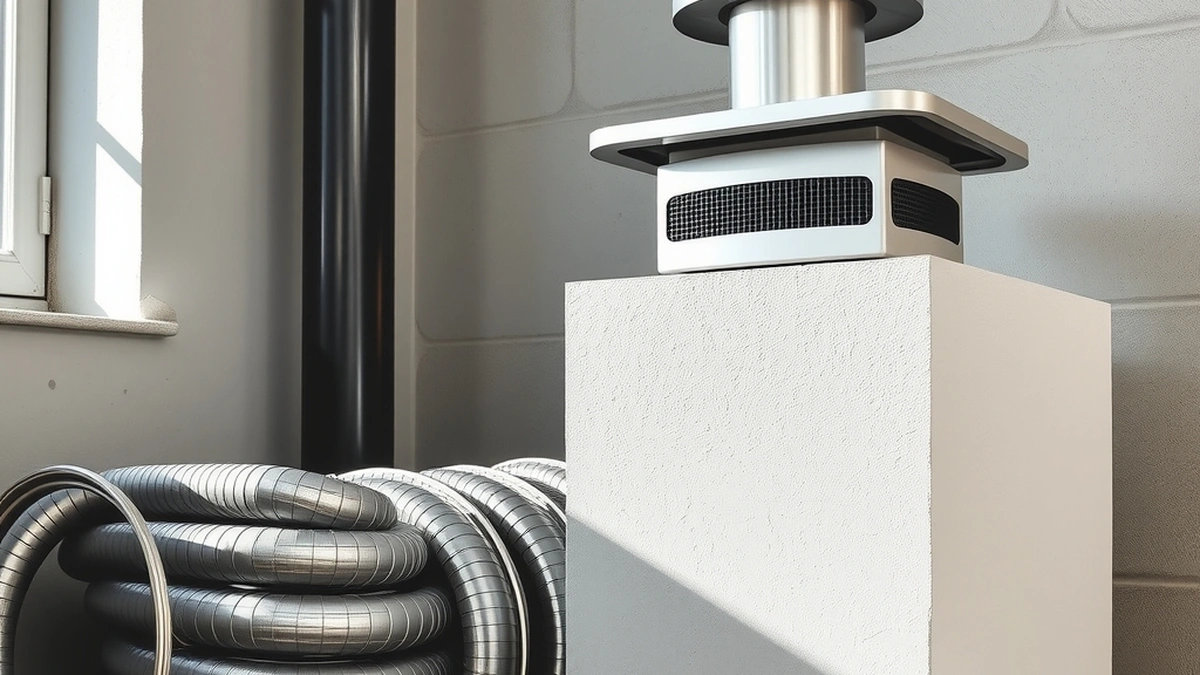
Stainless relining costs $1,500 to $4,000 installed for one flue, or roughly $60 to $100 per linear foot. Alloy choice, diameter, insulation, and roof access move the number, and a second flue usually adds most of another single-flue price.
- One flue installed
- $1,500 - $4,000
- Per linear foot
- $60 - $100
- Alloy upgrade
- $100 - $400
- Cap, if added
- $150 - $600
Some links on this page are affiliate links.If you buy through them we may earn a commission at no extra cost to you. We do not accept payment for rankings. Read the full disclosure.
Stainless relining costs $1,500 to $4,000 installed for one flue, which is the same as saying $60 to $100 per linear foot across the range of heights most US houses have. The liner itself is rarely the expensive part. The height, the diameter, the insulation, and the access decide the invoice.
Two houses on the same street can be quoted $1,800 and $3,600 for what sounds like the same job. Usually one has a straight interior flue and the other has an exterior chimney, an offset, and a crown that will not seal.
What stainless relining is
Stainless relining is the installation of a corrosion-resistant stainless steel flue inside an existing chimney, connected to the appliance at the bottom and terminated with a plate and cap at the top. It restores a continuous, correctly sized passage without demolishing the chimney.
The liner is a system, not a pipe. It includes the liner, the insulation, the top plate, the cap, the appliance adapter, and the fasteners that hold it all together. A quote that prices only the pipe is pricing half a system.
Alloy and the price step
| Alloy | Where it belongs | Typical premium |
|---|---|---|
| 304 | Gas appliances, some wood | Base of the range |
| 316L | Wood, oil, coal, mixed use | $100 - $400 more |
| 316Ti | High-temperature and heavy wood use | Top of the alloy step |
The alloy question is a fuel question. Wood and oil produce acidic condensate that pits 304 over time, and the upgrade to 316L is cheap insurance on a job that costs thousands. For a gas appliance with low condensate, 304 is a reasonable specification and the premium buys little.
Ask the contractor to write the alloy on the quote. “Stainless” alone does not specify anything, and the difference between grades is invisible once the liner is in the chimney.
The per-foot math
The range reads cleanly per foot. Twenty-five feet at $60 per foot is 25 x $60 = $1,500. Forty feet at $100 per foot is 40 x $100 = $4,000.
The same 40 feet at $60 per foot would be $2,400, and the gap between that and $4,000 is the extras: scaffolding, insulation, a taller liner, and more hours. A 30-foot job at the midpoint of $80 per foot is 30 x $80 = $2,400, which is a fair planning number for a straightforward exterior chimney.
Diameter changes the material cost more than length does on short runs. An 8-inch liner uses about a third more metal per foot than a 6-inch, and the price step is visible on the quote even when the height is identical.
Corrugated versus smooth wall
| Wall type | Draft | Sweeping | Cost |
|---|---|---|---|
| Corrugated flexible | Adequate, slightly more resistance | Slower, catches residue | Lowest |
| Smooth-wall flexible | Better flow | Faster, cleans well | Small premium |
| Rigid sections | Best flow, straightest run | Easiest | Highest per foot |
Corrugated flex is the default because it bends around offsets and goes into flues that are not perfectly straight. Smooth-wall flex is a middle option that keeps most of the flexibility with less surface to collect creosote. Rigid is for straight runs where the extra cost buys the best draft and the easiest sweeping.
For a wood appliance swept every year, the smooth-wall premium is easy to justify. For a gas appliance with minimal residue, corrugated is fine.
What adds to the bill
Insulation is the first add and rarely optional on an exterior chimney. A wrapped liner keeps flue gases hot, improves draft, and reduces clearance to combustibles, and it adds material plus an hour of labor.
The top termination is the second. A top plate is part of the job; a cap is $150 to $600 on top of it. A crown that cannot be sealed adds $400 to $1,500, because the plate has to sit on something sound.
Tear-out is the third and the one that surprises. Breaking out old clay tile to fit a larger liner is a masonry task, not a liner task, and it can double the labor. Offsets and damper frames are the fourth: an ovalized liner or a cut damper frame adds time and material.
Stainless versus cast-in-place
| Factor | Stainless reline | Cast-in-place |
|---|---|---|
| Typical cost | $1,500 - $4,000 | $100 - $250 per foot |
| 25-foot flue | $1,500 - $2,500 | $2,500 - $6,250 |
| Installation time | One to two days | Several days with cure |
| Best for | Straight flues, most retrofits | Irregular or badly damaged flues |
| Insulation | Wrapped, factory controlled | Integral to the pour |
Cast-in-place wins on a flue that is egg-shaped, offset beyond what a liner will pass, or so eroded that a flexible liner cannot seal. On a normal straight flue, stainless is cheaper and faster, and the decision is straightforward.
Getting the quote right
- Get the inspection first, with photographs of the flue at three heights.
- Require the alloy, diameter, and liner type on the written quote.
- Require the insulation spec, and whether it is a wrap or a blanket.
- Require the top termination details: plate size, seal method, cap included or not.
- Require the bottom connection: adapter, tee, or insert collar.
- Ask what happens if the flue will not take the liner, and who pays for the attempt.
Is it worth the money
The comparison that matters is against the alternative, which is a rebuild at $5,000 to $15,000. A reline at $1,500 to $4,000 that buys another twenty years of service is the cheaper path by a wide margin, and it is the correct path whenever the brick is sound.
The comparison that does not work is relining a chimney that is falling down. Water in the masonry, spalled brick, and a failed crown are structural problems, and a liner installed over them fails early and takes the money with it.
For the job-level breakdown, see chimney relining cost. For the installation, see stainless relining installation. For what goes wrong afterward, see stainless relining problems. For the poured option, see cast-in-place liner vs stainless relining.
Frequently asked questions
How much does stainless relining cost?
Between $1,500 and $4,000 installed for a single flue, which works out to roughly $60 to $100 per linear foot. Short flues sit at the bottom, tall or difficult flues at the top.
Is 316 stainless worth the extra cost?
For oil, coal, and wood appliances that run hard, yes. The upgrade is typically $100 to $400 on a residential job and it resists the acidic condensate that attacks 304.
Why is a 40-foot reline so much more than a 25-foot one?
More liner, more insulation, more labor at height, and often scaffolding. At $100 per foot, 40 feet is $4,000; at $60 per foot, 25 feet is $1,500.
Does the price include removing the old liner?
Not always. Breaking out old clay tile is a separate scope and can add a day or more. Ask whether the quote assumes the old tile stays in place.
Is a smooth-wall liner worth the premium?
It is easier to sweep and collects less creosote than a corrugated wall. The premium is modest, and on a wood appliance that is swept annually the smoother wall pays back over the liner's life.
How long does a stainless liner last?
Manufacturers typically warrant 316L and 316Ti liners for 20 years to lifetime, with terms tied to the fuel and appliance. Real service life depends on correct sizing, insulation, and annual inspection.
Sources
Some links are affiliate links.If you buy through them we may earn a commission at no extra cost to you. We do not accept payment for rankings. Read the full disclosure.