Spalling brick: warning signs to catch early
Early signs of spalling: brick dust on the roof, faces flaking in sheets, exposed inner brick, and white staining. What each stage means for repair cost.
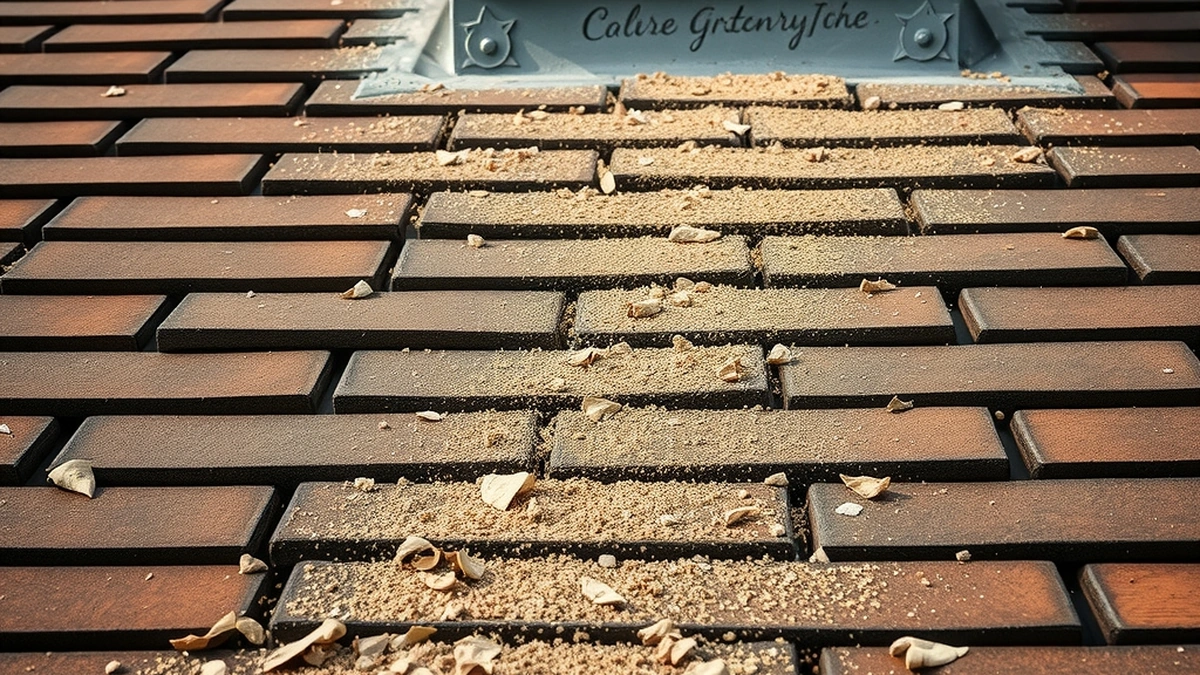
The warning signs of spalling are brick dust or flakes on the roof below the stack, faces flaking in sheets, the softer inner body of the brick showing, and white staining on the surface. Catching it early means replacing a few units at $400 to $1,500 rather than a rebuild.
- First sign
- Brick dust on the roof
- Second sign
- Faces flaking in sheets
- Late sign
- Inner brick exposed
- Repair a few units
- $400 - $1,500
- Rebuild if widespread
- $5,000 - $15,000
Some links on this page are affiliate links.If you buy through them we may earn a commission at no extra cost to you. We do not accept payment for rankings. Read the full disclosure.
The earliest sign of spalling is often not on the chimney at all. It is brick dust or small flakes on the roof below the stack, where they have dropped from faces breaking down. By the time the flaking is obvious from the ground, the bricks have been through several winters of freeze-thaw.
What spalling is
Spalling is the loss of a brick’s face, in flakes or sheets, exposing the softer body underneath.
It happens because water inside the brick freezes and expands, pushing the face outward until it separates.
The process is slow at first and then accelerates, because the exposed inner body absorbs water more readily than the fired face did.
The signs in order
| Stage | Sign | What it means | Action |
|---|---|---|---|
| 1 | Powdery surface, slight roughening | Face beginning to break down | Check the water paths |
| 2 | Brick dust on the roof | Material already dropping | Book an inspection |
| 3 | Flaking at the edges | Face separating | Plan replacement |
| 4 | Sheets coming away | Face gone in patches | Replace units |
| 5 | Inner brick exposed and eroding | Unit failing structurally | Replace or rebuild |
| 6 | Corners and top courses missing | Bond broken | Partial rebuild |
Stage 1 and 2 are the cheap interventions. Stage 6 is the $5,000 to $15,000 band.
Brick dust: the sign people miss
Brick dust on the roof below the stack is easy to mistake for grit from the shingles or debris from trees.
It is usually finer and more reddish than roof grit, and it accumulates directly below the chimney rather than across the whole roof.
If you see it, look up at the stack with binoculars. The faces will show a roughened, sandy texture before they visibly flake.
The flaking itself
Early flaking appears at the edges and corners of a brick, where freeze-thaw stress concentrates.
As it progresses, the flakes get larger and the pattern spreads across the face of the unit. Eventually the face comes away entirely, leaving the softer, lighter-coloured inner body exposed.
At that point the brick can no longer be protected by a coating. It has to be replaced.
White staining and what it does not mean
Efflorescence — white, powdery staining — is salts left behind when water evaporates from the masonry.
It is not spalling, and it does not mean the brick is failing. It does mean water is moving through the wall, which is the condition that leads to spalling.
If white staining appears alongside flaking, the diagnosis is water plus freeze-thaw. If it appears alone, the task is to find the water source before the brick starts to go.
Reading the pattern, and what each stage costs
Where the flaking appears tells you where the water comes from.
Flaking near the top of the stack: the crown.
Flaking at the base, near the roof line: the flashing.
Flaking in a band beside fresh mortar joints: a mortar mismatch from a previous repointing job.
Flaking on one face only: prevailing weather driving rain against that side.
The pattern is often more informative than the amount.
What each stage costs.
Stage 1 and 2: an inspection at $150 to $800 and a crown or flashing repair at $400 to $1,500.
Stage 3 and 4: brick replacement and repointing at $400 to $1,500, plus the water fix.
Stage 5 and 6: partial rebuild at $5,000 to $15,000, plus a crown at $400 to $1,500 and a cap at $150 to $600.
The cost curve is steep and it is entirely predictable from stage 2 onward. That predictability is useful: it means the decision to act is not about whether the damage will spread, only about how quickly.
What to do at the first sign.
- Photograph the stack from the ground with the zoom on.
- Check the roof below for brick dust.
- Book an inspection at $150 to $800 rather than a repair visit.
- Ask which water path is feeding the damage.
- Fix that path before commissioning masonry work.
The fourth step is what stops the repair repeating. Replacing brick under a leaking crown is money spent twice.
Do the check in spring, after the freeze-thaw season. Winter is when the damage happens, and spring is when it is cheapest to fix, before the next cycle starts.
Signs that are not spalling.
Three lookalikes are worth ruling out.
Mortar smears from a previous repair. Grey or sandy patches on the brick face that do not flake.
Efflorescence. White and powdery, and it brushes off.
Soot staining. Black deposits from smoke, usually near the top or around a flue terminal.
None of those involve loss of the brick face, and none need brick replacement.
The test that separates them is simple: press a fingernail into the marked area. If material comes away in a flake with a sharp edge, it is spalling. If it smears or brushes off as powder, it is a deposit on a sound face.
Where the flue fits, and what to check each spring
Spalling is a masonry condition. It says nothing about the flue.
A cracked liner or a flue that is the wrong size for the appliance is a venting issue, and it belongs with a qualified chimney technician. A stainless liner at $1,500 to $4,000 is the usual repair when the flue is involved.
Our spalling brick repair guide covers the masonry work, spalling brick prevention covers the routine, and spalling brick cost prices each stage.
Frequently asked questions
What does the start of spalling look like?
A slight roughening of the brick face, often with a powdery deposit or fine dust below the chimney on the roof. The face then begins to flake at the edges.
Why is there brick dust on my roof?
It is usually the earliest visible sign of spalling: faces breaking down and dropping material. Brick dust below the stack means units are already losing their surface.
How fast does spalling progress?
It accelerates. One winter may remove a thin layer; after several, the face is gone and the inner body of the brick starts to erode. Catching it early is what keeps the repair small.
Can spalling stop on its own?
No. The freeze-thaw cycle continues as long as water is entering the brick. Fixing the water source slows it, and replacing the failed units repairs it.
Is white staining on brick always spalling?
No. Efflorescence is salts left by evaporating water and can appear on sound brick. It indicates water movement rather than face loss, but it is a warning that water is present.
When does spalling mean a rebuild?
When most of the exposed stack has lost its face, when corners or top courses are missing, or when the inner wythe has crumbled. That is the $5,000 to $15,000 partial rebuild band.
Sources
Some links are affiliate links.If you buy through them we may earn a commission at no extra cost to you. We do not accept payment for rankings. Read the full disclosure.