Flashing repair maintenance: the yearly check
Flashing needs a yearly look in autumn plus a check after storms. What to inspect from the ground and the signs that mean a roof-line visit.
Flashing maintenance is a yearly inspection from the ground, plus a check after any storm that strips shingles or drives rain sideways. Look for lifted metal, sealant beads on the brick, rust stains, and damp masonry below the roof line.
- Check frequency
- Yearly, plus after storms
- Repair cost
- $400 - $1,500
- Crown repair
- $400 - $1,500
- Inspection
- $150 - $800
- Repair life
- 20-50 years by metal
Some links on this page are affiliate links.If you buy through them we may earn a commission at no extra cost to you. We do not accept payment for rankings. Read the full disclosure.
Flashing maintenance is a yearly look from the ground, plus a check after any storm. You are looking for lifted metal, a bead of sealant on the brick, rust staining, and damp masonry below the roof line. Catching those early keeps a $400 to $1,500 repair from becoming a carpentry and masonry problem.
Why flashing needs checking at all
Flashing seals the joint between the chimney and the roof, and that joint moves constantly.
The roof and the chimney expand and contract at different rates, the structure flexes, and the metal has to accommodate all of it while shedding water.
Metal fatigues, fasteners loosen, sealant hardens, and shingles age. None of that is dramatic, and all of it is visible long before water reaches the ceiling.
What to check from the ground
| Check | Where to look | What it means |
|---|---|---|
| Lifted metal | Edges at the chimney base | Fasteners or bond failed |
| Sealant bead on brick | Horizontal line above flashing | Counter-flashing not cut in |
| Rust staining | Metal and brick below it | Corrosion, near end of life |
| Damp masonry | Brick below the roof line | Water entering at the joint |
| Shingle damage | Around the chimney | Path opened for water |
| Moss or debris | In the joint and valleys | Water held against the metal |
| Interior staining | Chimney breast and ceiling | Leak already established |
The last row is the one that means the problem is no longer preventive.
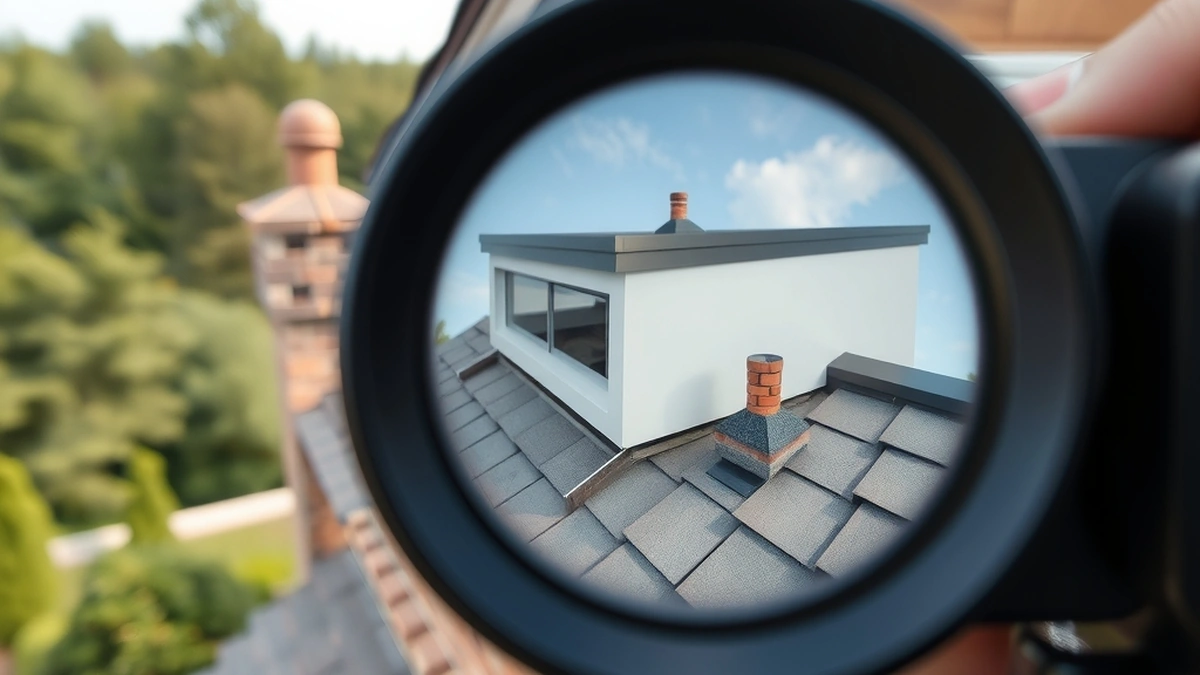
Two of those checks are worth doing with a camera. Photograph the flashing from the same spot each year, zoomed to the joint, and keep the images together. A one-millimetre lift in year one is hard to see in isolation and obvious against last year’s photo, and that is exactly the kind of slow change that ends in a rotted deck.
The autumn check
Late autumn is the right time, before the wet and freezing season.
- Clear leaves and debris from the roof around the chimney, using a pole from the ground where possible.
- Look at the flashing with binoculars in raking light; lifted edges show clearly.
- Check the brick below the flashing for dark, damp patches.
- Look for a horizontal sealant bead, which means a previous shortcut.
- Check the crown and cap in the same pass, because they are the other water paths.
If any of those raise a question, book an inspection rather than climbing up. A fall from a roof is a far worse outcome than a repair bill.
After a storm
Wind-driven rain is the test that finds flashing defects.
A leak that appears only in storms, or only on one side of the chimney, is almost always flashing. Normal rain runs down the roof and away; wind pushes it sideways and uphill into joints that are otherwise dry.
Check after any storm that strips shingles, brings down branches, or drives rain against the chimney face. Note where the water appears inside, and photograph it, because the location tells a technician which side of the flashing to examine.
What maintenance cannot prevent
Three failures are not maintenance issues.
A counter-flashing installed on the surface rather than cut into the masonry will fail regardless of how often it is checked. The fix is a proper reglet, not more sealant.
Flashing installed under old shingles, or left in place during a re-roof, has a sequence defect that only shows up when the layers separate.
A roof deck that has already rotted will not hold new fasteners. That is carpentry before metal.
In each case, the maintenance check finds the problem; it does not solve it. What the check does buy is time: knowing that the joint is failing lets you book a roofer in the dry season rather than calling an emergency number after a storm, which is both cheaper and more likely to be done properly.
The other water paths
Flashing is one of four ways water enters a chimney.
The crown sheds water from the top. A flat or cracked crown sends water down the stack, and the leak appears in any heavy rain rather than only in wind.
The brick face absorbs water. Damp masonry with no interior staining points there, and repointing is the repair at $400 to $1,500.
The flue opening takes rain directly if the cap is missing. A cap at $150 to $600 closes it.
Checking all four in one pass is what makes the yearly walk worthwhile. Our chimney leak repair guide covers the diagnosis, and crown rebuild reviews covers the top-of-stack repair.
When to book a professional
Book an inspection at $150 to $800 when any of the following is true: a leak appears in wind-driven rain, the metal is lifted or rusted through, there is a sealant bead on the brick, the masonry below the flashing stays damp, or the flashing has not been examined in more than five years.
The inspection report should cover the flashing, crown, cap, and the flue. The flue is a venting system, and its assessment belongs with a qualified chimney technician rather than a roofer.
What maintenance saves
A flashing repair at $400 to $1,500 is the routine cost of a failed joint.
Water that runs behind the flashing for a few years rots the deck, which adds carpentry, and saturates the masonry, which adds repointing. Left long enough, the masonry damage reaches the partial rebuild band of $5,000 to $15,000.
The yearly check costs nothing but time, and it is the cheapest point in that progression to intervene. For pricing, see flashing repair cost; for the failures, flashing repair problems.
Frequently asked questions
How often should flashing be checked?
Once a year, ideally in autumn before the wet season, and again after any storm that damages shingles or drives rain sideways. Most failures announce themselves in wind-driven rain first.
Can I inspect flashing myself?
From the ground with binoculars, yes. Anything at the roof line is technician work, because it involves working at height and often lifting shingles.
What are the signs of failing flashing?
Lifted or curled metal, a bead of sealant on the brick, rust staining, damp masonry below the roof line, and water stains on the chimney breast inside the house.
How long does flashing last?
Copper and lead commonly last 50 years or more; galvanised steel 20 to 30. Most failures are installation or sealant related rather than the metal reaching its limit.
Does flashing maintenance include the crown?
They should be checked together because both are water paths. Repairing one while the other leaks wastes the first job, and both sit in the $400 to $1,500 band.
What does a flashing repair cost?
Commonly $400 to $1,500 with roof access. A full rebuild with new metal and any deck repair costs more.
Sources
Some links are affiliate links.If you buy through them we may earn a commission at no extra cost to you. We do not accept payment for rankings. Read the full disclosure.