Crown rebuild problems: why new crowns fail
Why rebuilt chimney crowns crack and leak again: missing overhang, no bond break, bad slope, poor mix, and masonry movement below. Symptoms mapped to causes.
Most crown rebuild problems trace to four details: no overhang, no bond break at the flue tile, too little slope, or a pour over moving masonry. A crown that cracks again within two seasons was almost always formed wrong the first time.
- Repair after failure
- $400–$1,500
- Rebuild estimate
- $1,000–$3,000
- Diagnostic inspection
- $150–$800
- Masonry rebuild below
- $5,000–$15,000
Some links on this page are affiliate links.If you buy through them we may earn a commission at no extra cost to you. We do not accept payment for rankings. Read the full disclosure.
Crown rebuild problems are almost always forming problems. A crown that fails inside two seasons was usually poured flat, poured flush with the brick, or poured tight against the flue tile with no bond break. The concrete itself is rarely the culprit. The good news is that the failure pattern tells you which detail was skipped, and the pattern is visible from the roof.
The four details that decide everything
A crown has one job and four requirements. It sheds water away from the flue and the masonry, which means it needs slope, an overhang with a drip edge, adequate thickness, and a joint that lets the flue tile move independently.
Skip slope and water stands on the crown. Skip the overhang and water runs down the chimney face. Skip the bond break and the first hot fire cracks the crown radially. Skip thickness and it cracks mid-span.
Reading the crack pattern
The direction of a crack is diagnostic.
Radial cracks run from the flue tile outward to the edge of the crown. They mean the crown is locked to the tile and the tile’s expansion tore it. That is a bond break failure.
Circumferential cracks run in an arc parallel to the chimney walls. They usually mean the crown is too thin, or that the masonry below has settled and the crown is spanning a void.
Mid-span cracks across a wide crown point to missing reinforcement or reinforcement that was pushed to the bottom of the pour instead of centered.
Map cracking — a web of fine cracks across the surface — points to a mix that was too wet or cured too fast in sun or wind.
| Symptom | Most likely cause | Fix |
|---|---|---|
| Radial crack at the flue | No bond break | Rebuild with a compressible joint |
| Circumferential crack | Thin section or settled masonry | Rebuild, check masonry below |
| Cracks across the middle | Missing or misplaced mesh | Rebuild with centered reinforcement |
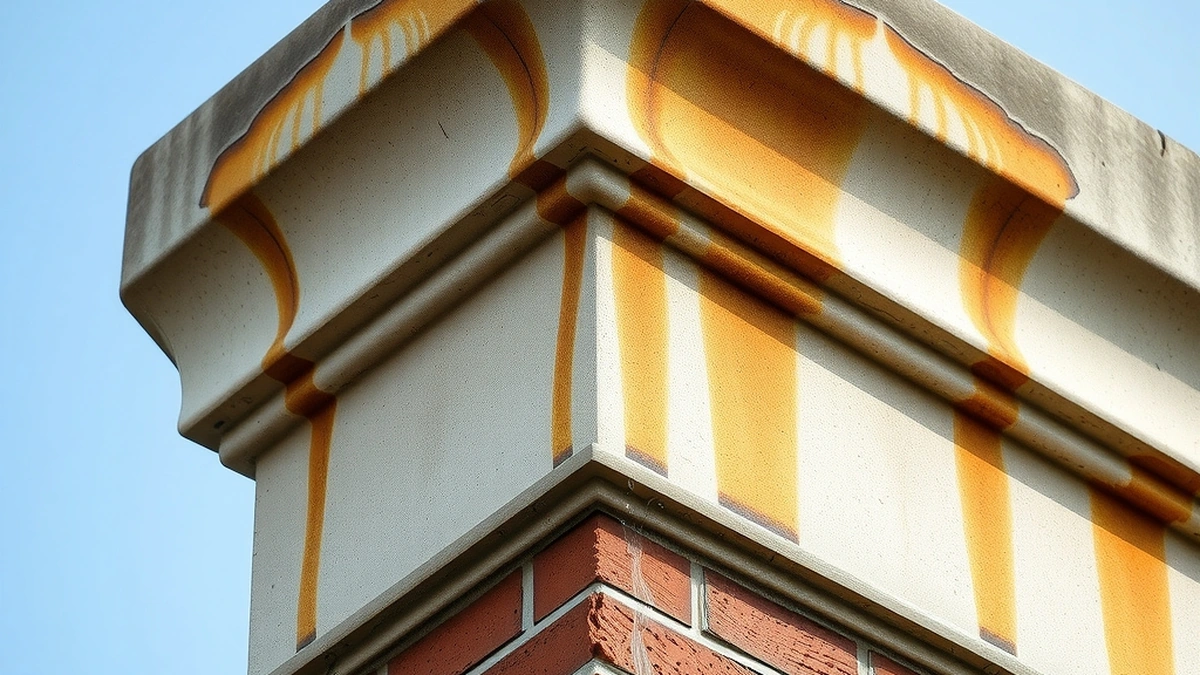
| Water streaks on brick face | No overhang or no drip edge | Rebuild with a two-inch overhang |
| Standing water on crown | Slope under one inch per foot | Rebuild with correct fall |
| Surface dusting and flaking | Wet mix or freeze damage | Rebuild or recoat depending on depth |
Water still running down the face
A crown with no overhang puts water directly onto the top of the brick. That water enters the joints, freezes, and spalls the brick face. Homeowners often describe this as “the crown leaking” when the crown is intact and simply too small.
The test is simple: stand back and look at the edge. If the concrete stops flush with the brick, there is no drip edge and the crown is dumping water onto the wall. That is a rebuild at $1,000–$3,000, not a sealant job.
Bond break failures
A bond break is a compressible strip or a sealant joint between the crown and the flue tile. Without it, the tile — which gets hot — expands against the crown, which stays cooler, and the crown cracks at the weakest section.
This is the most common reason a rebuilt crown fails early, and it is invisible from the ground. Ask the installer how the bond break is being formed before the pour, not after.
Mix and cure problems
Concrete placed too wet loses strength and shrinks more, which produces map cracking. Concrete placed in direct sun with no curing protection dries from the top down, which produces surface flaking that looks like a thin layer peeling.
Cold weather adds a third failure: water in the mix freezes before the concrete gains strength, and the surface is destroyed from the inside. Below about 40 degrees Fahrenheit, the pour needs protection or rescheduling.
The crown on failing masonry
This is the expensive one. If the top courses of brick are spalling or the joints are recessed and soft, the crown has nothing solid to sit on. A new crown poured over that movement will crack within a few seasons, no matter how well it was formed.
The repair is a partial rebuild at $5,000–$15,000. It is a different purchase from a crown, and a contractor who quotes only the crown on that chimney is quoting a repeat visit.
What to do when you find a problem
- Get on the roof or ask for photographs of the crown edge and the flue joint.
- Note the crack direction and whether there is staining along it.
- Tap the top three feet of masonry and listen for hollow or loose sections.
- Check the cap: a failed cap lets water onto the crown that the crown was not designed to handle.
- Get an inspection at $150–$800 that covers crown, cap, flashing, and the top of the flue.
- Decide between a repair at $400–$1,500 and a rebuild at $1,000–$3,000 based on crack depth, not crack count.
- If water appears inside the house, treat it as a leak investigation, not a crown problem, until flashing is ruled out.
The installation details behind each fix are in crown rebuild installation, and the price lines are in crown rebuild cost. If water is showing up indoors, chimney leak repair covers the flashing and masonry paths that a crown cannot fix.
Keeping a rebuilt crown alive is mostly annual inspection, covered in crown rebuild maintenance. And if the chimney has interior problems as well as a crown problem, compare the priorities in crown rebuild vs stainless relining before spending on the top only.
Frequently asked questions
Why did my new chimney crown crack?
The usual causes are a missing bond break at the flue tile, no overhang, too little slope, or a mix that cured too fast. A crown cast tight against a tile that expands with heat will crack along that line.
Should a crown have a bond break?
Yes. The crown and the flue tile move at different rates when the flue heats. A compressible strip or a sealed joint lets them move independently instead of cracking the crown.
How much overhang does a crown need?
At least two inches past the masonry face, with a drip edge so water drips clear instead of tracking down the chimney wall. A crown flush with the brick is a leak waiting for the first hard rain.
Can a cracked crown be repaired instead of rebuilt?
Sometimes. A surface crack on a sound crown can be cleaned and sealed for $400–$1,500. A crack through the full thickness, or one with staining beneath it, usually means a rebuild.
Why does water still come in after a new crown?
Check the flashing, the cap, and the masonry joints above the roofline. A crown sheds water from the top of the chimney, but it cannot stop water entering at a failed flashing or through spalled brick.
When does a crown problem mean a partial rebuild?
When the brick below the crown is loose, spalling, or cracked through. A new crown over failing masonry will crack again, and the masonry repair runs $5,000–$15,000.
Sources
Some links are affiliate links.If you buy through them we may earn a commission at no extra cost to you. We do not accept payment for rankings. Read the full disclosure.