Types of chimney: a field guide for homeowners
Masonry, factory-built, direct-vent, and the connectors that are not chimneys. What each type is made of, how long it lasts, and what it costs to keep working.
There are two chimney families, masonry and factory-built, plus sealed direct-vent systems that are not chimneys in the traditional sense. Each type dictates its own liner, clearance, service life, and repair bill.
- Masonry service life
- 50–100 years
- Factory-built service life
- 20–30 years
- Stainless liner
- $1,500–$4,000
- Cap installed
- $150–$600
Some links on this page are affiliate links.If you buy through them we may earn a commission at no extra cost to you. We do not accept payment for rankings. Read the full disclosure.
There are two real chimney families and one pretender. Masonry chimneys are built on site from brick, block, or stone. Factory-built chimneys are assembled from listed metal components. Sealed direct-vent systems look like chimneys from the ground but are appliance venting, not flues you can sweep.
Which one you have determines the liner, the clearances, the service life, and every repair price you will be quoted.
The definition, and why type matters
A chimney is a vertical passage that carries combustion products from an appliance to open air. The construction type is the method used to build that passage, and it fixes three things you cannot change later without rebuilding: the clearances to combustible material, the liner system, and the maximum temperature the assembly is rated to withstand.
That last one separates a chimney from a hazard: a clay tile flue, a listed factory chimney, and a sealed direct-vent pipe are each tested to different standards, and a component from one cannot legally substitute for another.
The main types compared
| Type | Construction | Liner | Service life | Typical cost to keep working |
|---|---|---|---|---|
| Brick masonry | Brick and mortar on a foundation | Clay tile or cast-in-place | 50–100 years | Crown $400–$1,500, reline $1,500–$4,000 |
| Stone masonry | Stone with mortar, often older homes | Clay tile or stainless | 75–100+ years | Same as brick, higher repointing labor |
| Block masonry | Concrete block, often with a brick face | Clay tile | 40–70 years | Same, block spalls differently |
| Factory-built (Class A) | Listed metal pipe in a chase | Integral insulated liner | 20–30 years | Replace components, no rebuild |
| Direct-vent | Sealed double-wall pipe | Integral, appliance-specific | 15–25 years | Inspect termination and gaskets |
| Single-wall stovepipe | Black steel connector | None, connector only | 5–15 years | Replace as it corrodes |
Read the last column as a maintenance budget, not a purchase price. A masonry chimney asks for money at the top, in the crown and the cap, and inside, in the liner. A factory-built chimney asks for money when a component fails and the part is discontinued.
Masonry chimneys
Masonry is the type most people picture. It is built from brick, concrete block, or stone, usually with a clay tile liner inside and a concrete crown on top. Its advantage is repairability: repoint the joints, replace the crown, reline the flue, and a 70-year-old stack serves another 30 years.
Its great weakness is water. Brick is porous, mortar is softer than brick by design, and every freeze after a soak expands what got in. That is why the cap at $150 to $600 and the crown at $400 to $1,500 matter more than anything else on a masonry chimney. A stack with a sound crown and a cap outlives one without by decades.
Masonry also needs a foundation. When the footing settles, the stack leans away from the house and the flashing joint opens. That is structural, not maintenance, and it is where partial rebuilds at $5,000 to $15,000 come from.
Factory-built chimneys
A factory-built chimney is a listed assembly: insulated metal pipe, a support system, a chase, and a termination, all tested together as a unit. It is cheap, light, and fast to install, which is why it dominates furnaces and wood stoves.
The critical rule is that the listing belongs to the assembly, not to the pipe. Replacing a damaged section with a different manufacturer’s pipe, or with a generic section from a home center, voids the certification and can void your insurance. Replace parts with the original part numbers, and if the manufacturer is gone, plan on replacing the run.
Factory-built chimneys typically last 20 to 30 years. They fail at the joints and the termination, where condensate and weather do their work.
Direct-vent and sealed systems
A direct-vent system pulls combustion air in through an outer pipe and pushes exhaust out through an inner one, both inside a sealed assembly. It is standard on modern gas fireplaces, high-efficiency furnaces, and many gas stoves.
It is not a chimney in the sweeping sense: no open flue, no creosote, nothing to brush. What it needs is inspection of the termination for blockage by snow, nests, or frost, and a check that gaskets and joints are sound. A bird nest in a direct-vent termination will shut down a furnace, and it is a five-minute fix if someone looks.
The connector that is not a chimney
Single-wall black stovepipe connects a stove to a chimney. It is not a chimney: no insulation, and clearance to combustibles that surprises people who have seen it run close to a wall in an old photo. It corrodes from the inside out, and a pinhole in a connector is a carbon monoxide path.
If your stove connects to a thimble with a short run of black pipe, that pipe is a service item with a shorter life than anything else in the system.
How to identify what you have
- Look at the exterior. Brick or stone with mortar joints is masonry. A metal pipe in a framed chase is factory-built.
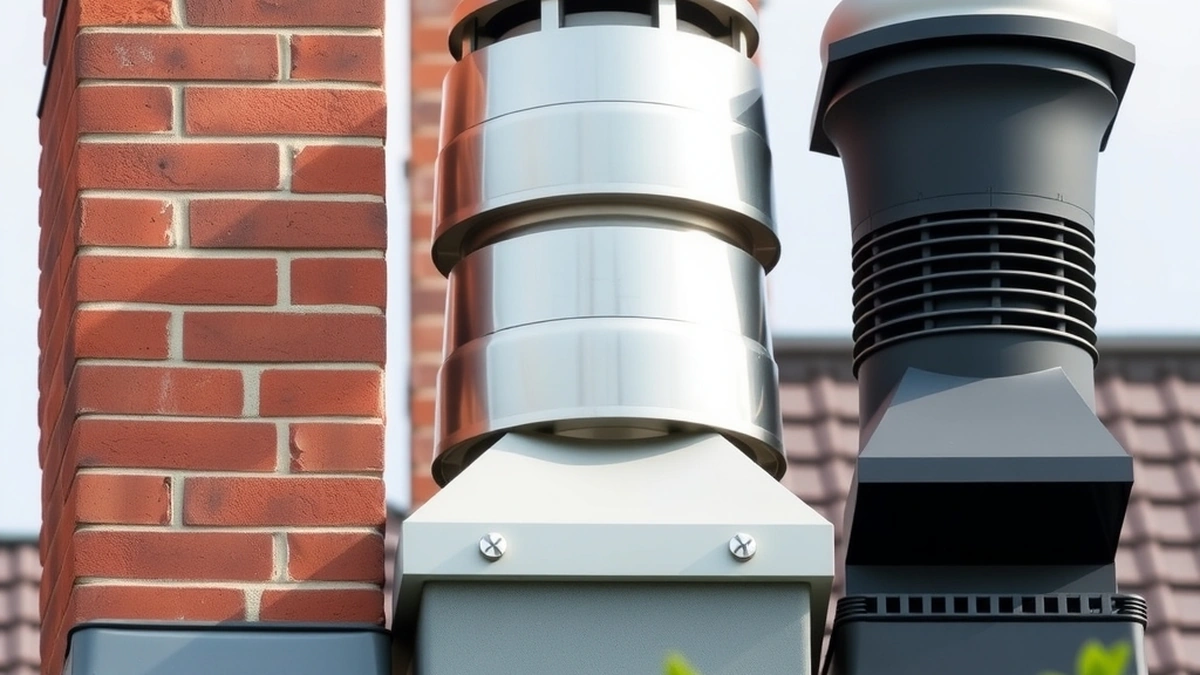
- Look at the termination. A rectangular concrete cap over tile flues means masonry. A round metal cap with a screen on a pipe means factory-built. Two concentric pipes mean direct-vent.
- Look in the attic or the chase. Insulated metal pipe with a listed label is factory-built; the label gives you the manufacturer and the model.
- Look at the firebox. Brick firebox with a damper is a masonry fireplace. A steel box with a glass front and a data plate is a factory-built fireplace or an insert.
- Check the appliance manual for the venting category it requires. That document overrides everything you infer from looking.
For the repair costs that follow each type, see chimney repair cost and how long does chimney last. If your flue turns out to be unlined, the relining options are covered in stainless steel chimney liner and crown rebuild vs stainless relining.
Matching type to appliance
The mismatch that causes the most trouble is an oversized masonry flue serving a modern appliance. A clay tile flue built for an open fireplace is far too large for a wood stove or a furnace, so the gases cool, condensate forms, and the mortar joints between tiles deteriorate.
Factory-built chimneys avoid this because the pipe diameter is selected for the appliance. Direct-vent systems avoid it entirely by being part of the appliance’s certified assembly.
The practical rule: if you change the appliance, re-check the vent. Swapping a fireplace for an insert, or a natural draft furnace for a high-efficiency one, changes what the flue must do. That check costs an inspection at $150 to $800 and prevents a $1,500 to $4,000 reline done at the wrong size. For appliance-specific guidance, see chimney liner for wood stove and chimney liner for furnace.
Frequently asked questions
What are the main types of chimney?
Masonry chimneys built from brick, block, or stone, and factory-built chimneys made from listed metal components. Sealed direct-vent systems are a third category that vents through a wall or roof without a traditional flue.
How do I tell if my chimney is masonry or factory-built?
Look at the outside. Brick or stone with visible mortar joints is masonry. A metal pipe inside a framed chase, or a metal termination on a roof, means factory-built or direct-vent.
Can a factory-built chimney be repaired like a masonry one?
No. Factory-built chimneys are certified as an assembly, so parts are replaced with the original manufacturer components. Mixing brands or substituting pipe sections voids the listing.
What is a Class A chimney?
Class A is the UL listing category for factory-built chimneys rated for solid fuel appliances, tested to withstand a 2,100 degree F chimney fire for ten minutes without structural failure.
Does a direct-vent system need sweeping?
No. Sealed direct-vent systems on gas appliances have no open flue to sweep, but they still need periodic inspection of the termination and the condensate path.
Which chimney type is cheapest to maintain?
A sealed direct-vent metal system has the lowest routine cost because there is nothing to sweep. Masonry costs the most over time, mostly because of water damage at the crown and flashings.
Sources
Some links are affiliate links.If you buy through them we may earn a commission at no extra cost to you. We do not accept payment for rankings. Read the full disclosure.